









Prevention of wounds and NWS myasis
■ Measures should be implemented to prevent animal wounds and avoid
NWS myiasis.2
• To the extent possible, eliminate or delay performing wounding procedures such as dehorning, branding, shearing, ear notching, tail docking and castration.2
• Livestock should be handled with care, and pens should be inspected for sharp objects.2
• Measures should be taken to protect livestock from other woundcausing parasites, such as ticks.2
• Untreated umbilical cords of newborn animals and foot lesions are commonly infested sites.2
■ Immediately treat all wounds with approved insecticides (see below); it may also be prudent to follow up with precautionary spraying of animals with insecticide before transport.2
Health/Safety/PPE of first responders or farmers & ranchers
■ If responders have open wounds, those injuries should be thoroughly cleansed and covered.2
■ For most responders, the appropriate level of personal protective equipment (PPE) during screwworm response efforts will be level D.2
• Level D is the lowest level of protection, and requires only a basic work uniform to protect the body against contamination and no respiratory protection.2
• Disposable gloves, and possibly cut-resistant gloves (if warranted by specific activities), are needed for hand protection. Some response activities may require the use of
protection higher than level D.2
Cleaning & disinfection
■ Because NWS larvae are obligate parasites, requiring living flesh to remain viable, it is extremely unlikely that larvae would be transported on animal products or byproducts.2
• There is a small risk that carcasses of very recently deceased animals might still be infested, and they should be thoroughly checked before leaving the control area.2
• Be aware that larvae typically and rapidly vacate a wound and pupate when the host animal dies.2
■ NWS larvae normally pupate in about 1 inch of soil, but pupation can occur anywhere there is a slight buildup of organic material, such as in feces. Maggots can also pupate in other protected sites, like cracks and crevices, or below bedding materials.2
• Areas where infested or susceptible animals have been held, including vehicles, must be immediately and thoroughly cleaned and treated with insecticide.2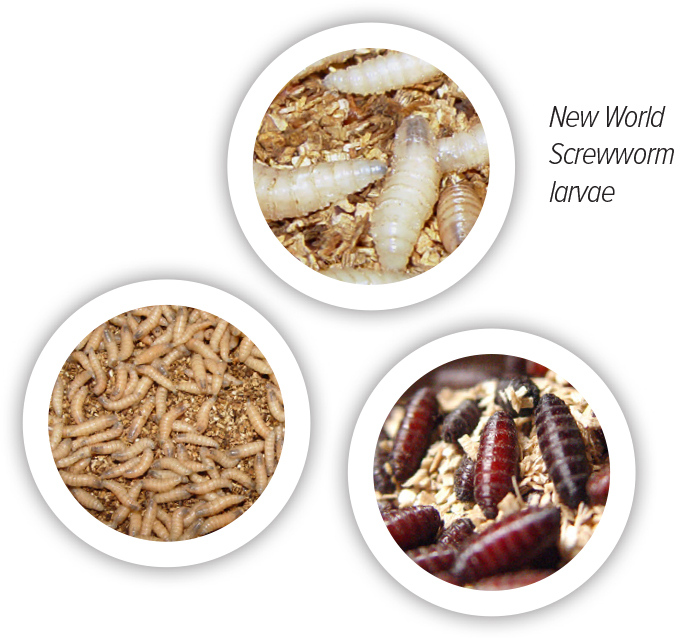
• Animal material that may contain viable pupae, such as manure, should be disposed of in a manner that will conclusively kill that stage; incineration is preferred.2
• To avoid these situations, inspections and cleanings of transport vehicles should be conducted in areas with concrete or otherwise hard and sealed floors. Trucks, trailers or other conveyances used to transport infested animals should also be treated with insecticide before further use.2

References:
1. https://www.aphis.usda.gov/sites/default/files/nws-pest-card.pdf
2. https://www.aphis.usda.gov/sites/default/files/nws_myiasis_disease_strategy.pdf
Images: https://www.aphis.usda.gov/sites/default/files/bro-new-world-screwworm.pdf